
Author

Hungarian Oscar-winner Laszlo Nemes returns with Moulin, a bleak and unadorned historical biopic chronicling the harrowing final days of French Resistance icon Jean Moulin. Screening in competition at the Cannes Film Festival, this intense wartime drama trades cinematic flair for a gritty, factual exploration of sacrifice, offering a timely tribute to a national hero.
Moulin Movie Review: Laszlo Nemes Delivers an Austere Cannes Wartime Drama
With right-wing populism surging globally, the cinematic resuscitation of historical anti-fascist icons feels both deliberate and necessary. In the Moulin movie review, Hungarian auteur László Nemes (Son of Saul) tackles the tragic, final chapters of Jean Moulin, the legendary French Resistance leader who was captured, interrogated, and tortured to death by the Gestapo in 1943. What emerges is a stolid, challenging biopic that strips away traditional Hollywood sentimentality in favor of a grinding, historically precise prison procedural.
The Plot Overview: From Espionage Thriller to Captivity Drama
The narrative of Moulin opens with the gripping, lo-fi energy of a classic spy noir. Parachutes descend through an inky, pitch-black night sky as Jean Moulin (played by Gilles Lellouche) lands in occupied territory to assume his role as the first president of the National Council of the Resistance.
The film’s first act effectively captures the claustrophobic paranoia of underground tradecraft. Audiences are plunged into a world of dark cobblestone streets, curls of cigarette smoke, and furtive glances. Director Laszlo Nemes drops the viewer directly into the chaos, offering little exposition regarding secondary characters or strategic operations, which effectively mirrors the disorienting reality of wartime espionage.
However, the tone shifts radically when a raid by the Gestapo results in Moulin’s arrest. The movie abruptly transitions from a tactical thriller into a grueling, claustrophobic prison drama. The remainder of the runtime focuses heavily on Moulin’s unwavering refusal to yield critical intelligence—specifically, the location of the impending Allied invasion—to his Nazi captors.
Cast and Character Portrayals: Steely Defiance vs. Sociopathic Cruelty
The emotional weight of the film rests on the shoulders of its two lead actors, who deliver starkly contrasting performances:
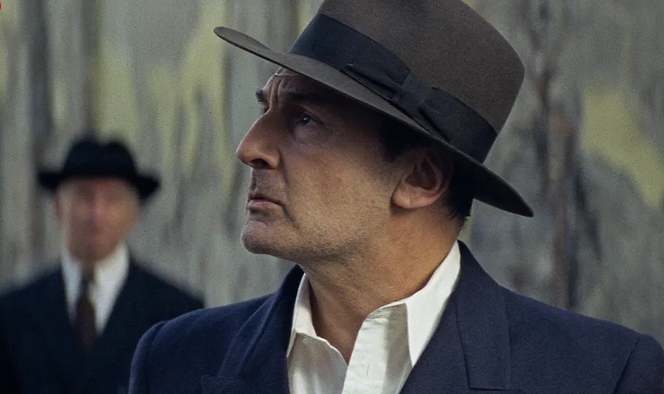
- Gilles Lellouche as Jean Moulin: Lellouche portrays the French icon as an impassive, stoic force of nature. For the majority of the film, he functions almost as a living monument, internalizing his immense suffering. It is only in the film’s final moments that cracks form in his armor, revealing glimpses of profound vulnerability—whether pleading with a fellow inmate for a merciful execution, showing tenderness to a cellmate, or defiantly singing an anthem before a firing squad.
- Lars Eidinger as Klaus Barbie: Eidinger delivers a chillingly calm, electric performance as the notorious Gestapo official overseeing Moulin’s interrogation. Bringing a petulant, sociopathic arrogance reminiscent of Ralph Fiennes’ iconic portrayal in Schindler’s List, Eidinger serves as the narrative’s volatile lightning rod, anchoring the audience’s collective disgust and driving the tension upward whenever he is on screen.
Direction and Technical Aspects: A Dispassionate Aesthetic
In this Moulin movie review, special mention must be made of Nemes’ directorial choices. Unlike Son of Saul, which utilized a frantic, shallow-focus camera technique, Nemes opts for a highly formal, detached aesthetic here.
Cinematography and Editing
Cinematographer Mátyás Erdély shoots the film in an austere palette of deep blacks and pallid, newsprint yellows. The visual style is handsome yet purposefully draining, successfully recreating the grim atmosphere of occupied France. Péter Politzer’s editing keeps the narrative tightly focused, cutting abruptly rather than lingering on melodramatic beats.
Music and Sound Design
Laetitia Pansanel-Garric’s score is remarkably restrained. Nemes explicitly avoids using swelling, manipulative music to underscore Moulin’s heroism. Instead, the film relies heavily on sound design to convey horror. By keeping the most graphic acts of violence off-screen—such as the auditory implication of a prisoner being mauled by dogs—the technical team emphasizes psychological dread over pure shock value.
Moulin Movie Review: Overall Verdict
Ultimately, Moulin functions more like a stark, just-the-facts documentary than an inspirational cinematic biopic. Screenwriter Olivier Demangel avoids broader political context, historical codas, or deep speculation regarding who betrayed Moulin (only briefly hinting at the long-suspected René Hardy).
While the film will undoubtedly stir deep patriotic sentiment within French audiences, international viewers may find its un-editorialized, bleak approach difficult to engage with emotionally. Nemes operates under the philosophy that to graphically depict historical trauma is to honor it. While the film’s meticulous craft is undeniable, it leaves audiences pondering a fundamental question: Should a hero be remembered for the grueling mechanics of his death, or for the ideals he died trying to protect?
Our Rating: 3.5 / 5 Stars
Frequently Asked Questions (FAQs) on Moulin Movie Review
Is the movie Moulin based on a true story?
Yes. Moulin is a historical biopic based on the real-life final days of Jean Moulin, a high-ranking hero of the French Resistance during World War II who died in Nazi custody in 1943.
Who directs the Moulin movie?
The film is directed by Hungarian filmmaker Laszlo Nemes, who previously won an Academy Award for his acclaimed 2015 Holocaust drama Son of Saul.
Who plays Klaus Barbie in the film?
The notorious Gestapo official Klaus Barbie is portrayed by German actor Lars Eidinger, whose performance is widely considered one of the highlights of the movie.
Where did Moulin premiere?
The film premiered in the official Competition section at the prestigious Cannes Film Festival.
Disclaimer on Moulin Movie Review
The views and opinions expressed in this article are solely those of the original author and do not necessarily reflect the official policy or position of this website. This review is intended for informational and entertainment purposes only. Images and credit details belong to their respective production houses.